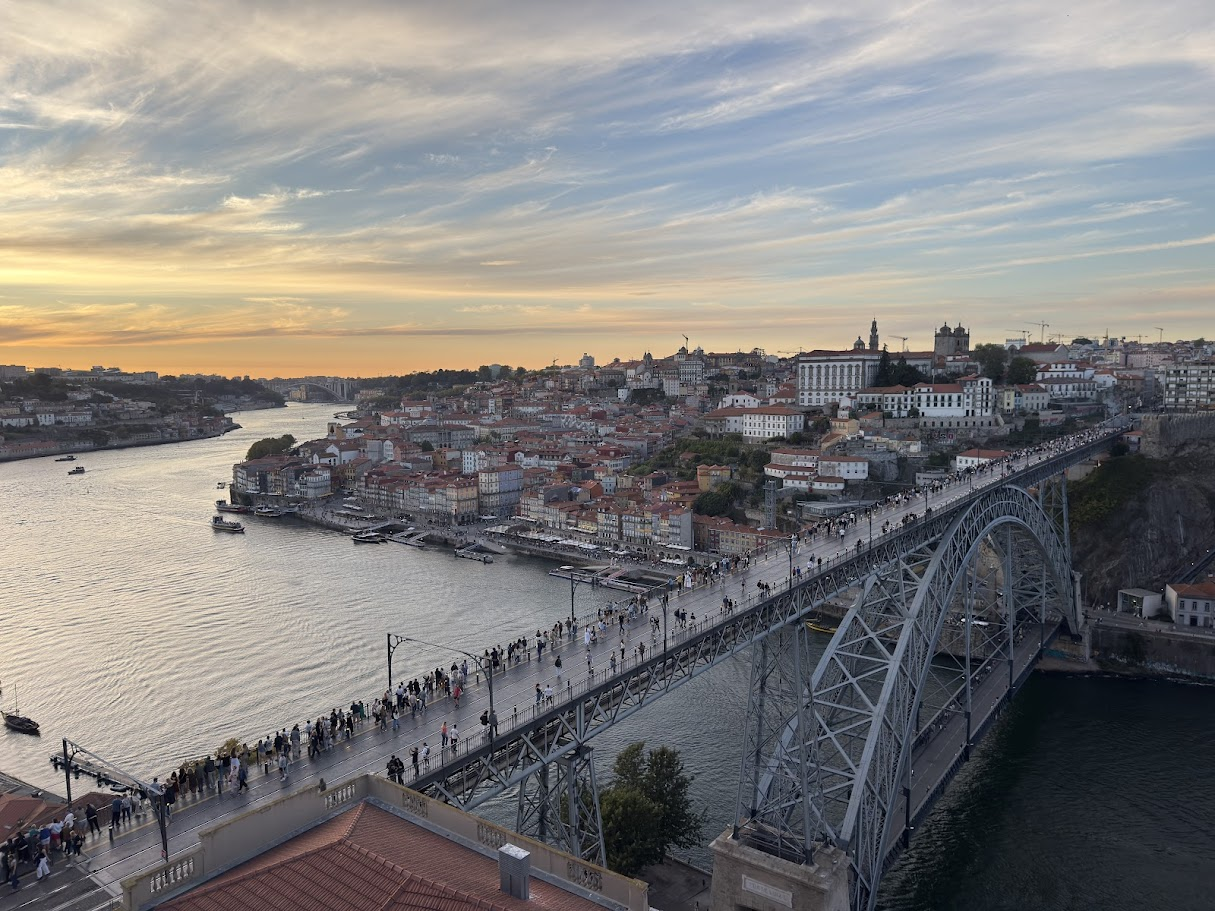
Porto is a city that doesn’t need to try too hard. It leans against the Douro River, stacked in layers of color and history, a little weathered around the edges but completely magnetic. You don’t come here for perfection. You come because it feels real.
The old town of Ribeira is where you start to understand what makes Porto unforgettable. The narrow lanes twist like a labyrinth, revealing balconies covered in laundry and old tiles that shimmer when sunlight hits them. The streets are steep, uneven, and alive with voices. Every corner feels like it leads to a secret view of the river or a courtyard that time forgot.
Walk toward the Dom Luís I Bridge and you will find one of the most striking cityscapes in Europe. The bridge itself is a feat of ironwork designed by a disciple of Gustave Eiffel. From the upper level, the entire city stretches before you in warm shades of gold and terracotta. It is the kind of view that makes even the most seasoned traveler stop and stare.
The São Bento railway station is another reason Porto feels like stepping inside a story. The walls are covered in thousands of blue and white tiles that tell moments of Portuguese history. Even if you are not taking a train, it’s worth walking through to see the scenes unfold across the walls. Each panel feels like a mural that has something to say about where the city came from.
Across town, Livraria Lello might be the most beautiful bookstore in Europe. Its stained glass ceiling, curving staircase, and carved wooden details make it look like something from a fantasy film. Many believe it inspired parts of the Harry Potter series when J.K. Rowling lived here, and whether or not that is true, it feels entirely possible. Inside, the air smells of old paper and wood, and the atmosphere has that rare mix of calm and awe that book lovers recognize instantly.
Porto rewards those who explore slowly. Step into the neighborhoods beyond the main squares and you’ll find quiet cafés, tile-covered houses, and locals chatting at shop doors. The city is smaller than Lisbon, and that works in its favor. It feels walkable, intimate, and authentic.
Make time for the Douro River walk. The path along the water runs past boats, stone arches, and old warehouses that catch the afternoon light. Sit for a moment, listen to the water, and watch the reflections shift as the day fades. The sound of seagulls and the hum of conversation carry through the air.
If you need a change of pace, take a short metro ride to Matosinhos. It’s where city life meets the Atlantic coast. Wide beaches, waves, and open skies replace the cobblestones. Locals come here to breathe, to walk, and to watch the horizon stretch endlessly.
By evening, Porto glows. Streetlights shimmer on the river, and music drifts softly through the alleys. There is something cinematic about how the city settles into night. Even without grand monuments or polished perfection, Porto leaves its mark. It’s the kind of place that stays in your head long after you leave, replaying in fragments of light, water, and tile.
Porto is not a city you conquer or check off a list. It is a place you sink into. You walk, you look up, you listen. You let it move at its own rhythm. And when you go home, you’ll realize that the city changed something small but important in the way you see the world.