The Colosseum and Roman Forum
The Colosseum isn’t just a ruin—it’s an engineered spectacle. Built under Emperor Vespasian in 72 CE, it could hold around 50,000 spectators, each seated according to class, status, and gender. Its system of vaults and corridors was revolutionary, allowing crowds to enter and exit in minutes. The travertine exterior once gleamed white, and bronze clamps once held the stones together before they were stripped for later buildings.
Step outside and continue through the Roman Forum, once the heart of Roman civic life. What looks like scattered marble fragments were once temples, basilicas, and government offices layered over centuries. Stand between the Arch of Titus and the Temple of Saturn and try to imagine the noise: merchants shouting, senators parading, citizens arguing about empire.
From the Palatine Hill above, you see the plan of ancient power and urban order—the DNA of every European capital that followed.

The Pantheon: Geometry of Perfection
The Pantheon is architectural time travel. Built by Emperor Hadrian around 125 CE, it’s the best-preserved Roman building in the world. The dome, 43 meters wide, still holds the record for the largest unreinforced concrete dome ever built. The oculus at the top—9 meters across—connects the building to the sky, letting in a shifting column of light that acts as both sundial and spiritual compass.
The geometry is pure genius: the height to the oculus equals the diameter of the dome, forming a perfect sphere that could fit within the building’s interior. Renaissance architects studied it obsessively; Michelangelo called it “angelic, not human.” Today it remains a church, so step quietly. Time slows inside, and the air feels heavier, as if gravity itself were paying respect to the form.
The Vatican: Art, Faith, and Power
The Vatican isn’t just a religious capital—it’s a concentrated expression of human ambition. Inside its walls lies a state within a city, governed by centuries of belief, politics, and wealth. St. Peter’s Basilica, designed by Bramante, Michelangelo, and Bernini, is the ultimate Renaissance megastructure. The dome dominates the skyline, yet inside it’s the details that overwhelm: the polished bronze canopy over the altar, the mathematical order of space, the light filtering through golden windows.
The Vatican Museums stretch for kilometers, displaying the spoils and triumphs of Western art—from ancient sculpture to Raphael’s rooms. It culminates in the Sistine Chapel, Michelangelo’s frescoed universe where theology meets anatomy. Look up at the Creation of Adam, but don’t forget to look down—the marble floor beneath your feet is just as deliberate.
Piazza Navona and the Baroque Explosion
Once a Roman stadium, Piazza Navona is now a theater of Baroque drama. Bernini’s Fountain of the Four Rivers (1651) anchors the square, with figures personifying the world’s great rivers twisting around an ancient Egyptian obelisk. Across from it stands Borromini’s Sant’Agnese in Agone, its concave façade rippling like fabric. The rivalry between the two architects—whether myth or truth—feels alive in the tension between stone and space.
The piazza’s shape still echoes its athletic origins, and the surrounding buildings lean into the curve like spectators. Street artists, buskers, and café tables add to the performance. Sit with a coffee, and you’re participating in 2,000 years of human spectacle.
Trevi Fountain and the Ritual of the Coin
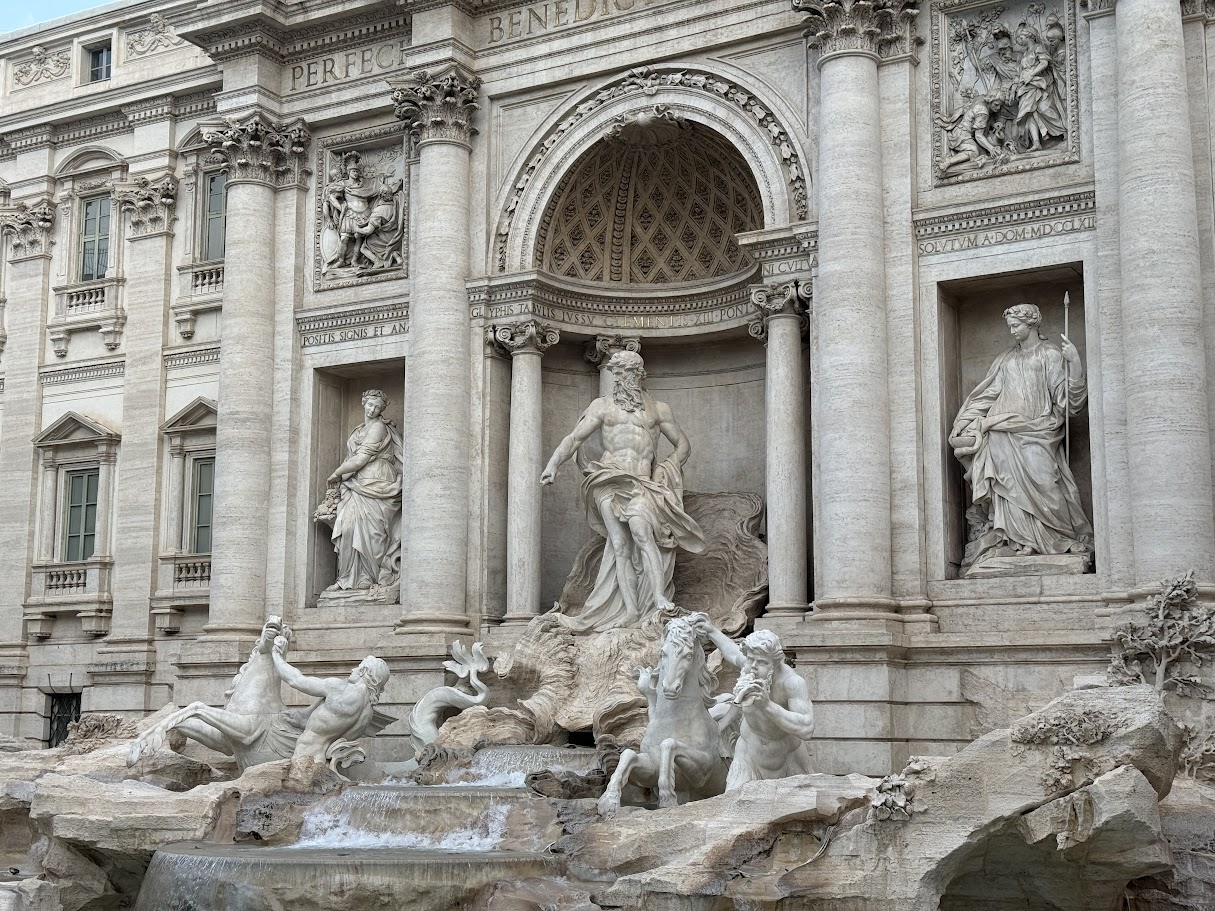
Rome’s most theatrical fountain is more than a selfie stop—it’s an allegory carved in travertine. Completed in 1762 by Nicola Salvi, Fontana di Trevi marks the end of one of Rome’s ancient aqueducts, the Aqua Virgo. The fountain’s composition is architectural: water bursts through a triumphal arch, spilling over artificial cliffs, with Oceanus commanding the center like a stage god.
The coin-throwing ritual (right hand over left shoulder) isn’t just tourist superstition—it began as a way to ensure your safe return to Rome. The coins collected, by the way, are gathered daily and used to fund food programs for the city’s poor. Visit early morning or late at night when the water’s roar fills the piazza and the marble glows silver.
The Spanish Steps and Via Condotti
The Spanish Steps connect the steep rise between Piazza di Spagna and the Trinità dei Monti church, forming one of the city’s most elegant open-air theaters. Completed in 1725, the steps were meant to bridge diplomacy and devotion—the Spanish embassy below, the French church above. The curves, landings, and irregular rhythm make it more than a staircase; it’s a civic landscape.
At the foot lies Via Condotti, Rome’s luxury artery, lined with fashion houses that echo the city’s long love affair with beauty and craftsmanship. But step aside from the main path and you’ll find narrow streets with century-old artisans—tailors, bookbinders, and shoemakers keeping analog Rome alive.
Capitoline Hill and Michelangelo’s Rome
The Capitoline Hill is where ancient authority meets Renaissance order. In the 16th century, Michelangelo redesigned the entire square, rotating its axis to face St. Peter’s rather than the Forum—a symbolic shift from empire to papal power. The resulting Piazza del Campidoglio is perfectly proportioned, an example of geometry controlling chaos.
At its center stands the bronze statue of Marcus Aurelius, a copy of the original housed in the Capitoline Museums nearby. Inside, you’ll find masterpieces like the Dying Gaul and the Capitoline Wolf, each a fragment of Rome’s evolving identity. From the terrace behind the museums, you get one of the best views over the Roman Forum—an architectural timeline written in stone.