The Eiffel Tower: The Iron Skeleton of Modernity
When it was built in 1889, Parisians hated it. Guy de Maupassant ate lunch in its restaurant just to avoid looking at it. Today, the Eiffel Tower is Paris itself—industrial, bold, unapologetically visible. Designed by Gustave Eiffel’s engineering firm, it was meant as a temporary exhibit for the World’s Fair, celebrating the centennial of the French Revolution. Its lattice ironwork wasn’t decorative; it was pure structure exposed to the sky, a statement that function could be beautiful.
Stand beneath it and look up—the geometry pulls your eyes through layers of steel like a cathedral made of air. The tower changes personality throughout the day: amber at sunset, spectral at night, and skeletal in winter fog. Every visitor takes the same photo, yet everyone sees a different tower.
The Louvre: A Kingdom of Fragments
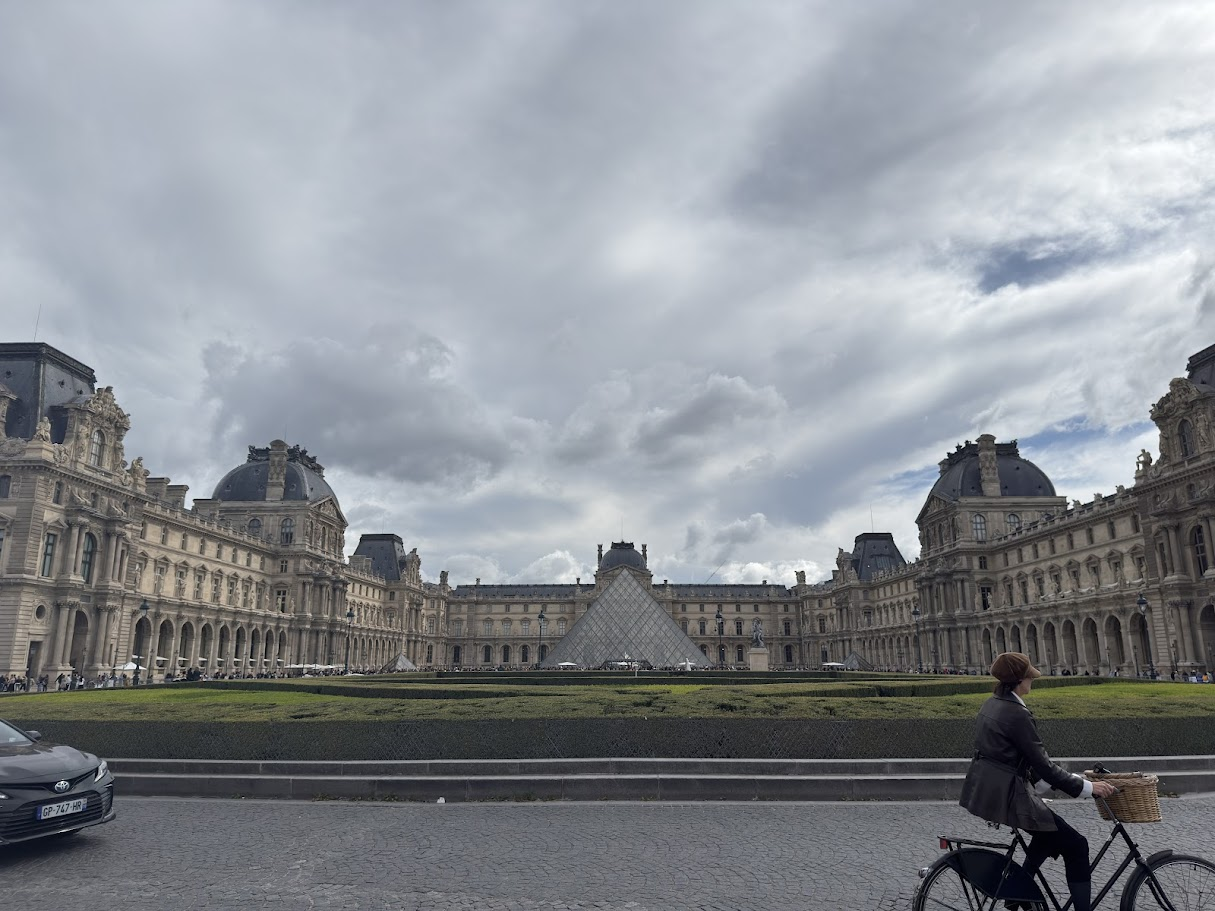
The Louvre isn’t one building—it’s a collection of centuries stacked like a geological record. From medieval fortress to royal palace to modern museum, it tells the story of power turned into culture. The glass pyramid by I. M. Pei, completed in 1989, caused outrage much like the Eiffel Tower did a century earlier. Now it’s hard to imagine the courtyard without it—an axis of light cutting through a labyrinth of history.
Inside, the scale is overwhelming: more than 35,000 works on display. Don’t rush to the Mona Lisa; she’s smaller than you expect and surrounded by phones. Instead, drift. Follow the marble folds of Winged Victory, the quiet shadows of Dutch still lifes, or the scarred surface of Egyptian stone. The Louvre rewards wandering, not checklisting.
Notre-Dame de Paris: The Heart Still Beating
Even scarred by fire, Notre-Dame remains the soul of Paris. Begun in 1163, it was among the first Gothic cathedrals to use flying buttresses—those stone arms that make walls float with impossible lightness. The building is geometry made spiritual: pointed arches rising toward heaven, stained glass filtering divine color onto stone.
When the 2019 fire tore through the roof and spire, Parisians gathered on the bridges, singing in the smoke. The restoration continues, a reminder that cities, like people, survive through repair. Stand on the square before it, the zero point from which all distances in France are measured, and you understand the phrase the heart of Paris.
Montmartre: The Hill of Dreams and Illusions
Montmartre feels like an old film that refuses to end. Cobbled streets twist uphill past cafés and studios, ghosts of Picasso, Modigliani, and Toulouse-Lautrec hiding in the walls. At the summit, the Basilica of Sacré-Cœur gleams white against the sky, its Byzantine domes intentionally un-Parisian—built after France’s defeat in 1871 as both penance and pride.
From the terrace, the city spreads like a mosaic of slate roofs and chimneys. But walk behind the basilica and the mood shifts: laundry between balconies, street musicians echoing in alleys, locals ignoring the tourists. Montmartre is equal parts myth and neighborhood—a place where the idea of Paris still pretends to live.
The Seine and Its Bridges: The River That Remembers
The Seine isn’t just a river; it’s the spine of Paris. The city began on its islands, Île de la Cité and Île Saint-Louis, and grew outward like ripples. Its bridges are time machines—the medieval Pont Neuf, the iron elegance of Pont Alexandre III, the minimalist arcs of newer crossings. Each one frames the city differently, revealing how light, water, and stone choreograph together.
At sunset, stand by the river between the Louvre and the Orsay. The reflections double the skyline. The boats slide under arches that have seen revolutions, coronations, and heartbreak. The Seine carries all of Paris downstream, century after century, whispering that beauty doesn’t have to last to matter.
The Arc de Triomphe and the Axis of Power
The Arc de Triomphe is Napoleon’s monument to himself, commissioned in 1806 to honor his army. Its scale is almost absurd—fifty meters high, carved with reliefs of soldiers charging into eternity. But it’s not just a monument to war; it’s the anchor of an urban vision.
From the top, you see the Champs-Élysées stretching east toward the Louvre and west toward La Défense—the historical and modern ends of French ambition. Every military parade, every national protest, seems to orbit this axis. Beneath the arch burns the Tomb of the Unknown Soldier, a flame rekindled each evening at 6:30. Paris remembers loudly and quietly at once.
The Musée d’Orsay: The Factory That Became a Masterpiece
Once a train station built for the 1900 Exposition Universelle, Musée d’Orsay is a triumph of adaptive reuse. Its vast iron-and-glass hall now houses the world’s greatest collection of Impressionist art—Monet, Degas, Renoir, Van Gogh—all displayed under a clock that once measured train schedules.
There’s a strange poetry in that: a space built for departures now holds moments frozen in light. Stand before a Monet water lily or a Degas dancer and you feel the pulse of a city that always reinvented itself through vision and revolt.
Versailles: Power’s Most Beautiful Prison
Just outside the city, Versailles was Louis XIV’s answer to chaos—an empire contained in symmetry. The Hall of Mirrors, the endless gardens, the fountains that obey geometry more than nature: everything here was designed to remind courtiers who ruled. It’s magnificent, exhausting, and strangely empty once you realize its perfection was built to control.
Still, no visit to Paris feels complete without stepping into Versailles’ impossible order, then leaving it behind to breathe again in the city’s messy, living streets.
Paris’s wonders are not just monuments—they’re arguments about art, power, and the passage of time. Each one tells a version of the same story: beauty is rebellion disguised as order