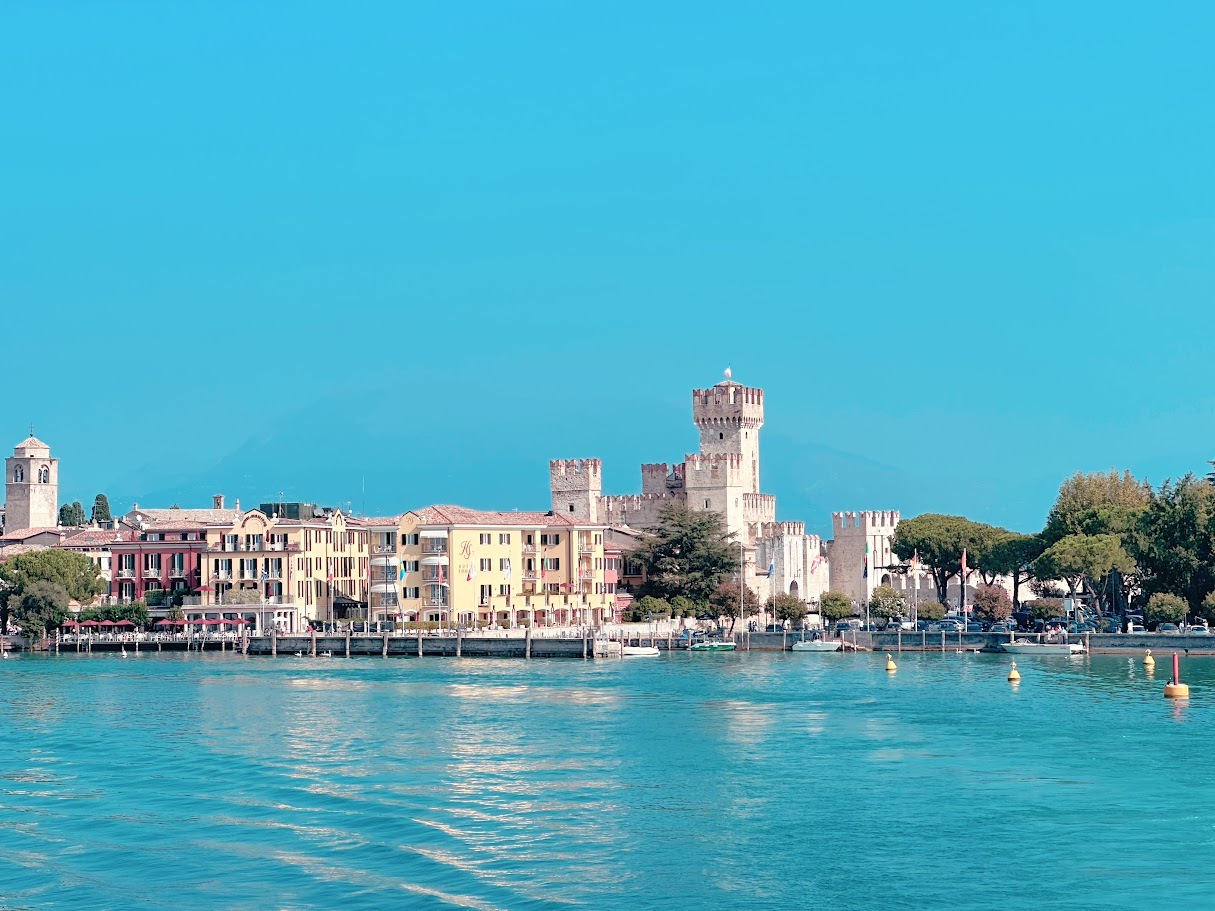
Sirmione sits like a finger pointing into Lake Garda, narrow and bright, surrounded on both sides by water that shifts from turquoise to deep blue with the wind. Visitors arrive across a small bridge that feels more like a threshold than a crossing. Once inside, the noise fades. The old town unfolds in cobbled lanes, flowered balconies, and café tables that never seem to empty.
The first thing you see is Scaliger Castle, a fortress from the 13th century built to guard the lake’s southern shore. Its towers rise from the water itself, mirrored perfectly in the moat. Walk the ramparts for a view that explains why this place has been fought over for centuries. The castle still looks ready for battle, though its modern enemies are camera lenses and gelato drips.
Farther along the peninsula lies the Grotte di Catullo, the ruins of a vast Roman villa that once belonged to a wealthy poet’s family. The site stretches across olive groves, its crumbling arches framing the lake like a painting. It is one of northern Italy’s most atmospheric archaeological sites, especially in late afternoon when the stone turns honey-colored in the sun.
Between the ruins and the castle, Sirmione hums with daily life. The town’s hot springs, known since Roman times, still draw visitors to thermal spas that promise relaxation with a view. Local shops sell olive oil and lemon-scented soaps, reminders that the climate here is as gentle as the landscape. For a quieter moment, walk the lakeside path outside town. The water laps against the rocks, swans drift past, and the mountains to the north look close enough to touch.
Evenings in Sirmione are slow and golden. The tourists thin out, and locals come down to the water for a walk or an aperitivo. The smell of grilled fish carries from open-air restaurants. The sunset spreads across the lake in colors that seem painted just for this small strip of land.
Sirmione is not about doing much. It is about noticing—the sound of church bells across the water, the way the light bends around the peninsula, the feeling that the world briefly makes sense when you stand between castle and lake.