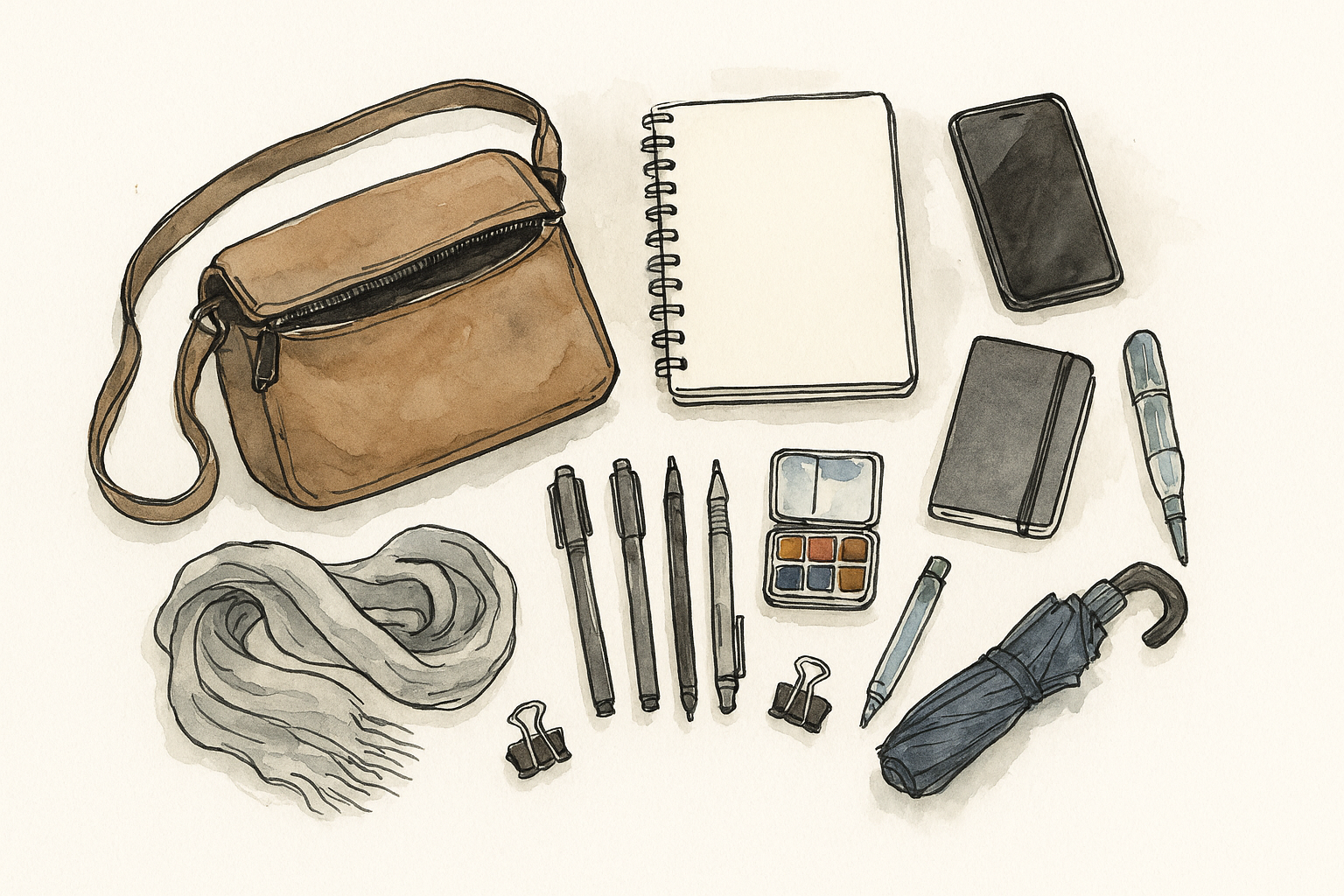
Why this bag exists in the first place
I love architecture. I love travel. I also love not carrying weight.
This is the bag that lets me walk a whole day in a new city, sketch buildings, drink coffee, get lost, and still have shoulders that function. It is not an ideal art store fantasy. It is the real kit that lives with passports, receipts, and emergency chocolate.
Take what works for you. Ignore the rest. The goal is simple
You can leave your room in ten minutes, with everything you need to draw.
The bag itself
I use a small crossbody bag that fits in front of my body, not behind.
What matters more than the brand
- It sits flat against your body
- It opens from the top or side facing you, not the street
- It fits a five by eight inch sketchbook upright
- It has at least one zip pocket for passport and cards
I do not bring a big backpack unless I am moving between cities. For sketch walks, the smaller the bag, the more you actually go out and draw. Large bags become lockers for anxiety. Small bags force decisions.
If you already own a normal crossbody bag, try that first. Do not buy a special art bag until you know what annoys you.
The sketchbooks
I keep it simple and rotate between two books.
Main book
One medium size sketchbook around five by eight inches, with paper that can take light washes of water. Hard cover is best so you can draw on your knees or a random bench.
Backup book
One pocket size notebook for moments when pulling the main book out feels too exposed. Think metro, busy bus, standing in line.
Why two books
The main one is for drawings you want to look at again. The small one is for ugly fast notes, tiny facades, people in line, overhead signs. When you accept that one book is allowed to be messy, you do not freeze.
Look for
- Paper that does not curl badly with light watercolor
- A cover that closes flat when held with one hand
- A color that can survive coffee spills and rain
Pens and pencils that actually get used
Here is the honest part. I have tested too many pens. I regularly use three.
Fineliner pen
Waterproof ink, medium tip. This is the main line for buildings, windows, roofs, street signs.
Brush pen or thicker marker
For shadows, trees, dark windows, people in the foreground.
Mechanical pencil
For mornings when my brain is not ready for permanent ink, or for planning scenes with tricky perspective.
Bring duplicates of the fineliner. They always die at the worst moment
sunset, beautiful light, last page of the sketchbook.
What I do not bring anymore
Fancy dip pens, huge marker sets, full pencil rolls. They look serious, but I rarely used them outside the room. If a tool is annoying to open in the street, it will stay in the bag forever.
The tiny watercolor setup
I like color, but not enough to carry a full studio.
I use a very small travel watercolor case. The important thing is not the brand, it is the number of wells. I keep it between eight and twelve colors.
My usual colors
- A warm and a cool blue
- A warm and a cool red
- A warm and a cool yellow
- One neutral like burnt sienna
- One gray or a mix I can reach fast
- One special color for the city
for example, a green for Lisbon tiles, a sandy tone for Rome, a gray blue for Zurich
One refillable water brush lives with the set. I do not carry a cup. I either use the water brush or a very small normal brush and a bottle cap.
Paper towel or a folded tissue sits in a corner of the palette. Always. You will drop too much water. You will need to lift mistakes.
Support gear that secretly matters more than art supplies
This is the boring but necessary part of the bag.
Phone and power bank
Maps, reference photos, tickets. I also sometimes take a quick photo before drawing to catch the light before it changes.
Clip or small binder clip
To keep sketchbook pages from flying like drama in the wind.
Bulldog clip or rubber band
To hang a pen or brush on the sketchbook while standing.
Mini umbrella or packable rain jacket
Nothing kills a sketch mood like random rain and wet paper.
Thin scarf or light layer
Good for sudden cold, for sitting on rough stone benches, or for modesty in certain places.
Earphones
Sometimes I sketch with city noise. Sometimes I need music or a podcast to stay put.
None of these items are romantic. All of them rescue real drawing days.
Solo safety and comfort built into the kit
Travel sketching does not live in a fantasy watercolor world. You are alone, in a real city, carrying gear and looking distracted. So the bag also answers this question
Can I leave quickly without dropping half my stuff.
Here is how I set things up
- Passport, cards, cash stay in the inside zip pocket
- Phone lives in the front pocket or a separate pocket, never on the sketching bench
- Sketchbook and pen go in and out of the same compartment every time
- The bag strap always crosses my chest, never hangs off one shoulder
When I choose places to sketch, I think like this
- I sit with my back against a wall whenever possible
- I avoid being the only person on a bench at night
- I do not spread my tools around me on the ground
- I always know how I would leave fast if I have to
None of this is paranoia. It is just design
The same way we plan exits and circulation for a building, we plan them for ourselves.
How a typical sketch walk looks in real time
This is what happens on a normal day with this bag in a new city.
Morning
I leave the hotel with the small bag, a bottle of water, and one snack. First stop is a café near a building I want to sketch. I order coffee, grab the main book and fineliner, and do a warm up sketch that nobody will see.
Late morning
I walk toward a square or a street with interesting facades. I look for a spot where my back is protected and my view is clear. Pen first, then light touches of watercolor. Nothing perfect. Fifteen to twenty minutes.
Afternoon
Energy drops. I move to an indoor space like a museum, church courtyard, library, or station hall. Here, the pocket notebook comes out. Small details, people in line, ceilings, staircases.
Evening
Golden hour. I choose one main view and commit. That is where the brush pen and darker washes come in. Strong shadows, big contrast. I put the book away when light disappears, not when the drawing is “finished”.
At every move, the bag closes completely. This habit matters more than any single tool.
Packing list you can copy and adjust
Here is the whole kit in one place
Core
- Crossbody bag that fits a five by eight inch book
- Medium sketchbook with decent paper
- Pocket notebook
- Two waterproof fineliner pens
- One brush pen or thick marker
- One mechanical pencil with spare leads
Color
- Small watercolor palette with eight to twelve colors
- One refillable water brush or one small brush and tiny bottle
- Tissue or a bit of paper towel
Support
- Phone and small power bank
- One or two clips or rubber bands
- Light foldable layer or scarf
- Earphones
- Small umbrella if the weather is unstable
This works for most cities. For serious hiking days, I cut it even more. For work trips with meetings, I might add a tablet for digital sketches, but the basic kit stays the same.
Final thought for other architect sketchers
You do not need a perfect kit to start. You need a kit that is light enough that you actually carry it.
Start with the bag, one sketchbook, and one pen. Add tools only when a real moment on the street makes you wish for them. That way every item earns its place, and your bag stays something you reach for, not something you feel guilty about leaving in the hotel.