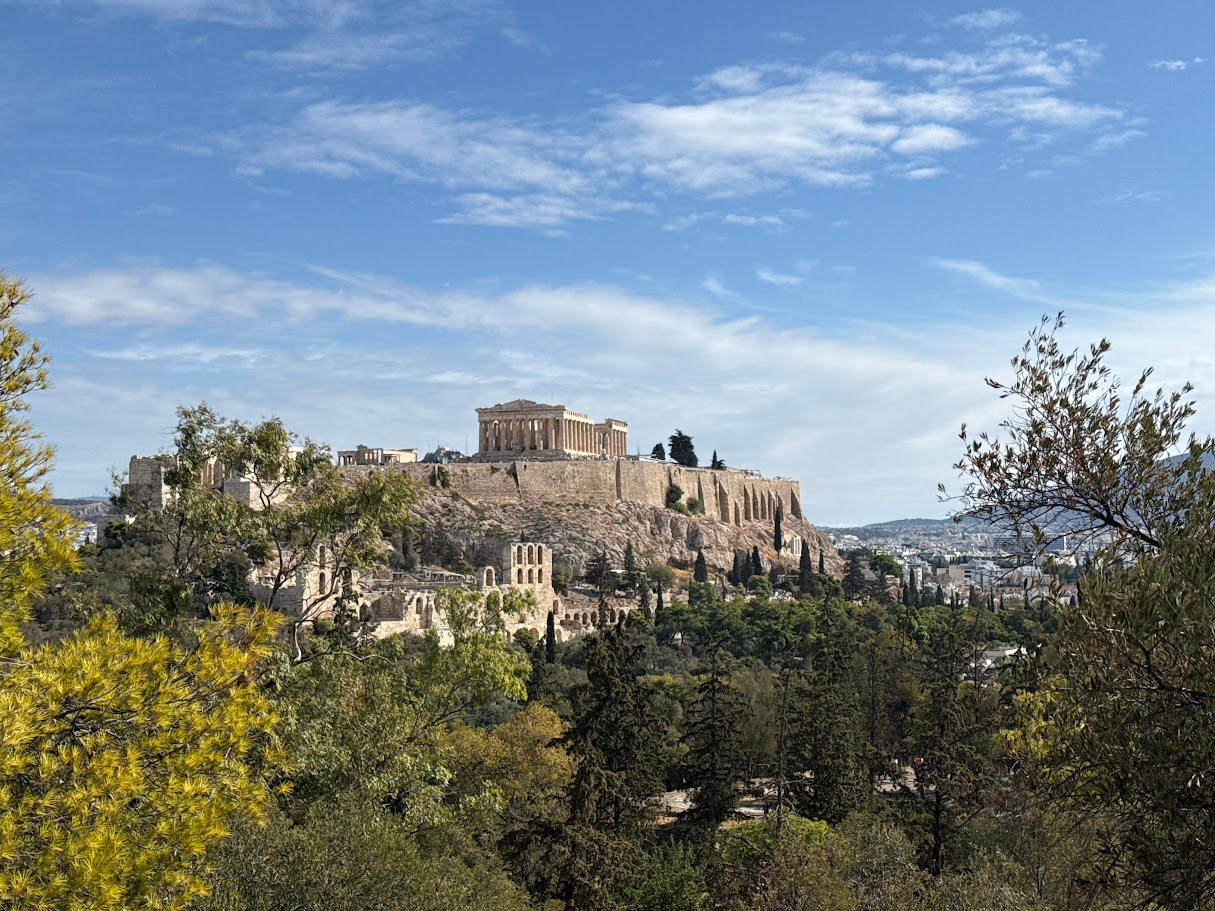
The Acropolis: The City’s Crown
Perched above the city, the Acropolis is more than a hill—it’s the blueprint of Western civilization. The Parthenon, dedicated to Athena, dominates the plateau with its Doric columns and perfect proportions, designed to be seen from every angle. Look closely at the friezes: they’re not just decoration but a narrative of Athenian identity, politics, and religion.
Nearby, the Erechtheion surprises with its asymmetry and delicate Caryatid columns—sculpted women supporting a roof as gracefully as they carry the weight of history. From the Acropolis, Athens spreads below in a mosaic of whitewashed buildings, hills, and distant mountains, reminding you that this city was planned to be seen as much as it was lived in.
The Ancient Agora: Where Democracy Was Born
At the foot of the Acropolis lies the Ancient Agora, the marketplace that doubled as the civic center. Walk the stoa-lined paths where philosophers debated, merchants sold goods, and citizens exercised early democracy. The Temple of Hephaestus, remarkably preserved, shows what Greek temples looked like in their prime, while scattered ruins hint at the scale of daily life two and a half millennia ago.
This isn’t just a ruin—it’s a classroom. Stand among the columns, imagine Socrates pacing these same stones, and feel the foundations of ideas that shaped the modern world.
Plaka: Living History
The Plaka neighborhood stretches beneath the Acropolis like a living museum. Cobbled streets, neoclassical houses, and hidden courtyards preserve the city’s soul. Cafés spill into narrow alleys, and shops sell local crafts, olive oil, and honey. Here, history isn’t behind glass—it’s around you, smelled, touched, and tasted.
Walking through Plaka, you feel the rhythm of Athens across centuries, from Ottoman occupation to modern life, layered like the strata archaeologists uncover in the city’s digs.
The National Archaeological Museum: Time in a Building
Athens’ National Archaeological Museum holds the richest collection of Greek art in the world. Bronze statues, Cycladic figures, and the Antikythera mechanism—a 2,000-year-old astronomical calculator—reveal the ingenuity of ancient craftsmen. Galleries are arranged to show development over centuries, making the museum itself a lesson in cultural evolution.
Don’t rush. Take the time to see the Mask of Agamemnon, the detailed frescoes, and the sculptures that once adorned temples. Here, the scale of achievement feels almost tangible.
Mount Lycabettus: Athens from Above
For the best city view, climb or take the funicular to Mount Lycabettus. From this vantage, the Acropolis, the Aegean Sea, and sprawling urban Athens converge. Sunset is magical—the city glows white, then gold, as the sea shimmers in the distance. Cafés at the summit invite you to pause and consider how Athens balances chaos and beauty, past and present.
Syntagma Square and the Hellenic Parliament
Syntagma Square is the beating civic heart of modern Athens. Watch the ceremonial changing of the Evzones in front of the Parliament building—a ritual dressed in tradition and precision. The square connects you to the city’s modern identity, linking ancient democracy to contemporary civic life.
Rewards!
Athens is a city that rewards curiosity. Climb, wander, and look up as much as you look down. Explore the ruins, but don’t miss the streets and cafés where the past still breathes into everyday life. Every corner tells a story—step in, and let the city teach you.