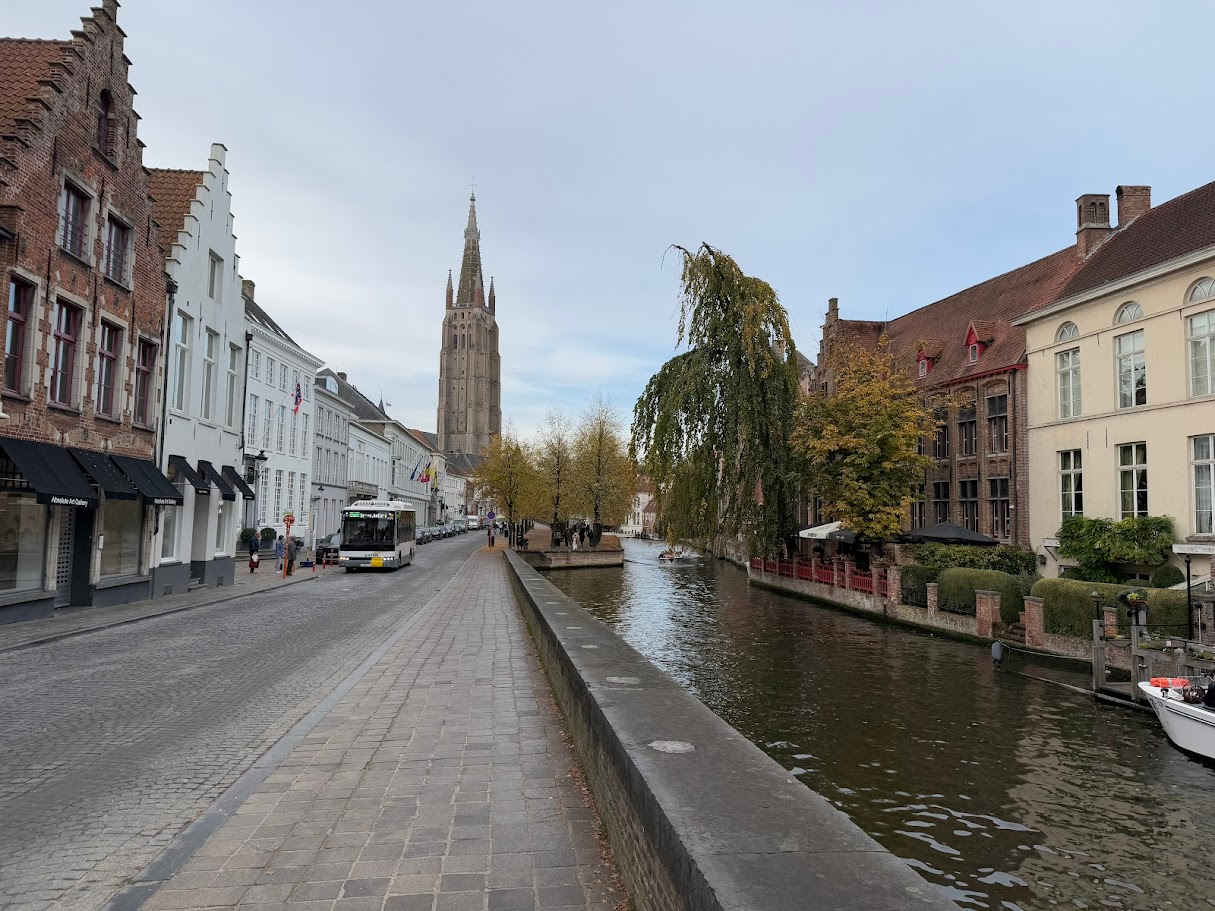
Bruges looks almost too perfect to exist. Cobblestone streets wind between canals, stone bridges reflect in the still water, and medieval towers rise over rows of gabled houses. It feels like someone pressed pause on time a few centuries ago and forgot to start it again.
Most visitors arrive expecting a postcard and find something stranger and deeper. Bruges rewards slowness. You do not visit to tick boxes or chase photos. You come to listen to the rhythm of a small city that still beats with its medieval heart.
Start in Markt Square, the open center of Bruges. The colorful buildings surrounding it once housed merchants and guilds that shaped the city’s wealth. The Belfry Tower rises above them, its bells marking every hour. Climb the narrow staircase to the top and the view opens like a painting. Roofs stretch out in warm colors, canals slice through the city like veins, and the horizon shimmers beyond the old walls.
From the square, wander wherever your curiosity takes you. Each turn brings a new reflection in the water or a courtyard hidden behind a curtain of ivy. The canals are the soul of Bruges, and they change mood with the light. Morning mist hangs low and turns the city into a dream. By afternoon, the water glows with reflections of brick and sky. Stand still on one of the bridges and you’ll hear soft footsteps, the distant ring of church bells, and the quiet ripple of passing boats.
Inside the Church of Our Lady stands Michelangelo’s Madonna and Child, the only sculpture by him to leave Italy during his lifetime. The church itself feels timeless, with light pouring through tall windows and echoing against stone. Its spire dominates the skyline, visible from nearly every corner of the old town.
Seek out the Begijnhof, a small world within the city. Whitewashed houses circle a peaceful garden filled with trees and silence. It was once home to women who lived spiritual lives without joining religious orders. Today, the same calm lingers in its walls, a rare pause in a busy world.
The Rozenhoedkaai is the most photographed place in Bruges, and when you see it, you understand why. The view brings together everything that defines the city. Water, towers, old façades, and sky. At sunset, the scene glows like a painting. People stop talking and simply watch the light change.
On the city’s edges, windmills still turn slowly when the wind rises. Small bakeries open their windows to the street, filling the air with the smell of warm waffles and sugar. Locals greet each other in passing. Bruges feels lived-in, not staged.
The beauty of Bruges is its quiet. Even when the crowds gather, there is always a lane or canal where you can hear nothing but your own footsteps. The city invites you to pay attention to details: the carvings above doors, the sound of church bells, the texture of stone polished by centuries of rain.
Stay into the evening. When night falls, the canals turn dark and still. Lights shimmer on the surface, and the sound of the city softens into silence. Walking through it at that hour feels like time travel. Bruges belongs to the night, and it reveals its best self when the streets empty.
Bruges is not a place to conquer. It is a place to drift through, to notice, to remember. You walk slowly, look up often, and let the past brush against the present. When you leave, the city follows you quietly, the sound of bells and water echoing long after you have gone.