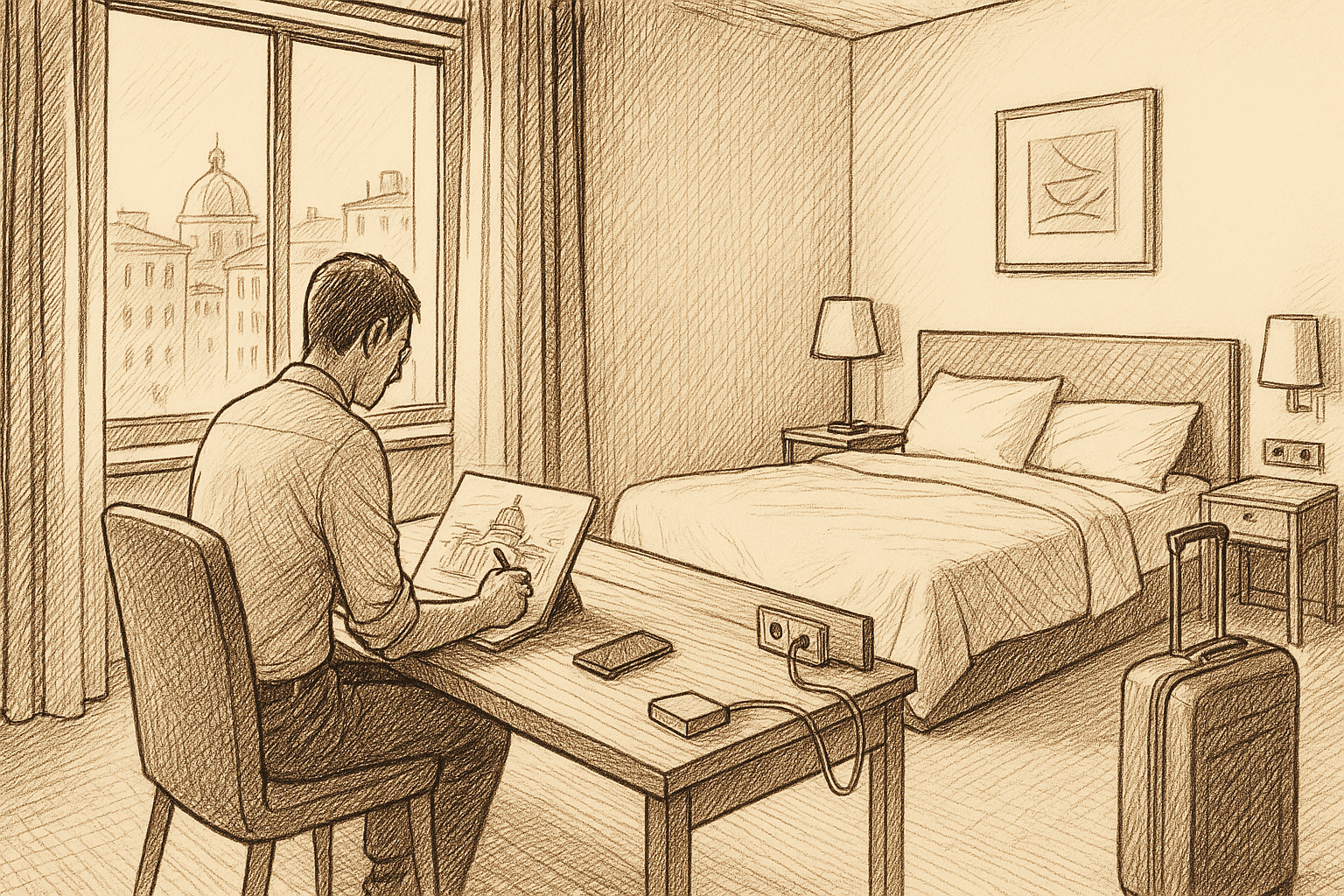
Why This Is Not A Pretty Hotel Review
Most hotel reviews talk about breakfast and rooftop bars. That is nice.
But if you are an architect traveler with a sketchbook and a laptop, you care about other things.
You need
- Enough sleep to function
- A place to sketch and work
- A location that does not kill your legs before you even start walking the city
This is how the decision really happens. Not what the brochure says.
Step One
Pick The Area Before The Hotel
I never start with a famous hotel name. I start with a map.
I ask three questions
- Can I walk to at least one interesting square or street in fifteen minutes
- Is there a metro or tram stop within five minutes on foot
- Does the area look active at night but not like a nightclub district
If the answer is yes to all three, I search only inside that zone.
A perfect room in a bad location is still a bad base.
Step Two
Look At The Floor Plan In Photos
Most people only see pillows and plants. I look for layout clues.
In the photos I check
- Where is the bed in relation to the window
- Is there a real desk or only a tiny shelf
- Can a chair slide under the desk without hitting the bed
- Is the suitcase supposed to live on the floor or is there a luggage bench
I imagine myself moving inside that room with a sketchbook, a laptop, and open bags.
If I already feel blocked just from photos, I skip it.
Step Three
Window, Curtain, And Light
Light makes or kills a room for anyone who draws.
I look for
- A real window, not a narrow slot
- Natural light on at least one side of the desk or table
- Curtains that reach the floor and actually close
Red flags
- Rooms described as interior view or courtyard view with very bright artificial lighting in photos
- Windows that seem to open directly onto an air shaft
- Photos where every angle is at night with only warm lamps, which often hides a lack of daylight
If I know I will be working in the evening, I look carefully at bedside lamps and ceiling fixtures.
You cannot fix bad lighting with a single travel candle.
Step Four
Noise And Sleep Quality
If sleep is bad, everything collapses.
In reviews I search words like
- Quiet
- Noise from street
- Thin walls
- Construction
- Bar downstairs
Patterns matter more than one angry comment.
If ten people in different months mention noise from a nearby club, I trust them.
I also check photos of the exterior.
- Rooms directly over a main street or tram curve are risky
- Rooms facing inner courtyards can be fine unless the courtyard is used by a restaurant
If the hotel is next to a hospital or fire station, sirens will be part of your life.
Step Five
Desk, Chair, And Outlets
This is where architect and sketcher needs overlap with remote work.
In photos I look for
- A surface where I can place a sketchbook and a laptop at the same time
- A chair that has a back and does not look like a torture device
- Power outlets near the desk and near the bed
If there is only a tiny round coffee table with a low fauteuil style chair, that is a red flag.
You will end up working on the bed, which kills both posture and focus.
I also check if there is at least one free wall with space to lean against while sketching on the bed or floor. No design awards here, just survival.
Step Six
Bathroom Reality Check
Architect brain likes nice tiles and glass partitions.
Tired traveler brain cares about something else.
I check
- Is the shower floor clearly contained or will water flood the entire bathroom
- Is there a shelf near the sink for toothbrush and sketch pencils that accidentally migrated
- Does the toilet look wedged into a strange corner
If reviews mention weak water pressure or unstable temperature, I assume mornings will be annoying.
Annoying mornings kill sketch energy.
Step Seven
Lobby, Lounge, And Hidden Workspots
One secret filter
Can I sit outside my room and draw without needing to order twenty coffees.
I check photos for
- A lobby with tables and chairs that are not only for check in
- A bar area or breakfast room that looks calm in off hours
- Any small terrace or courtyard
If a hotel has no shared space at all, I think twice.
Sometimes you need a change of scene to keep working or drawing in the evening without going to a cafe alone.
Red Flags That Make Me Close The Tab
These patterns almost always lead to frustration
- Rooms described as cosy with no clear photos of the full space
- Beds pushed directly against three walls, leaving only a narrow path
- Only wide angle lens photos that distort proportions of the room
- Many reviews mentioning smell, damp, or mold
- Photos with endless trendy decor objects but no storage
I also ignore emotional language from the hotel like
design inspired by the soul of the city.
If I cannot see the basic layout, that sentence means nothing.
When I Pay More And When I Do Not
I will pay more for
- Central area that saves me one hour of commuting every day
- Natural light and a real desk
- Good sound insulation and a firm mattress
I refuse to pay more just for
- Trendy lobby furniture
- Branded toiletries I will never finish
- Rooftop bars I will not use because I am editing photos in my room
Money saved on this nonsense becomes money for trains, museum entries, and sketchbooks.
How This Looks With Real Cities
Short examples, simplified but honest.
Rome
I accept slightly older interiors if the building is central and the room has a real window. Location beats perfect decor. I know I will spend most of the day outside sketching.
Zurich
Prices hurt. I look for business hotels near the station with good desks and quiet rooms. I forget about charm and focus on efficiency, because I will likely be using the room in the evening to work.
Paris
Rooms are usually small. I choose places where the bed is not blocking the window and there is at least one corner chair that can double as a sketch seat. I do not chase perfect Eiffel views. I just need breathable space.
Simple Checklist For Booking As An Architect Sketcher
Before I reserve, I run through this list
- Area works for walking and public transport
- Photos show a clear layout with a real window and some natural light
- Reviews are mostly calm about noise and sleep
- There is at least one surface and chair suitable for work and drawing
- Bathroom looks functional, not ridiculous
- Some kind of lobby or lounge exists for occasional sketching
If a hotel passes this test, then I look at price.
Not the other way round.
The goal is not to find a perfect designer paradise.
The goal is to get a room that quietly supports the work and sketching you came to do, instead of becoming another problem to solve.